
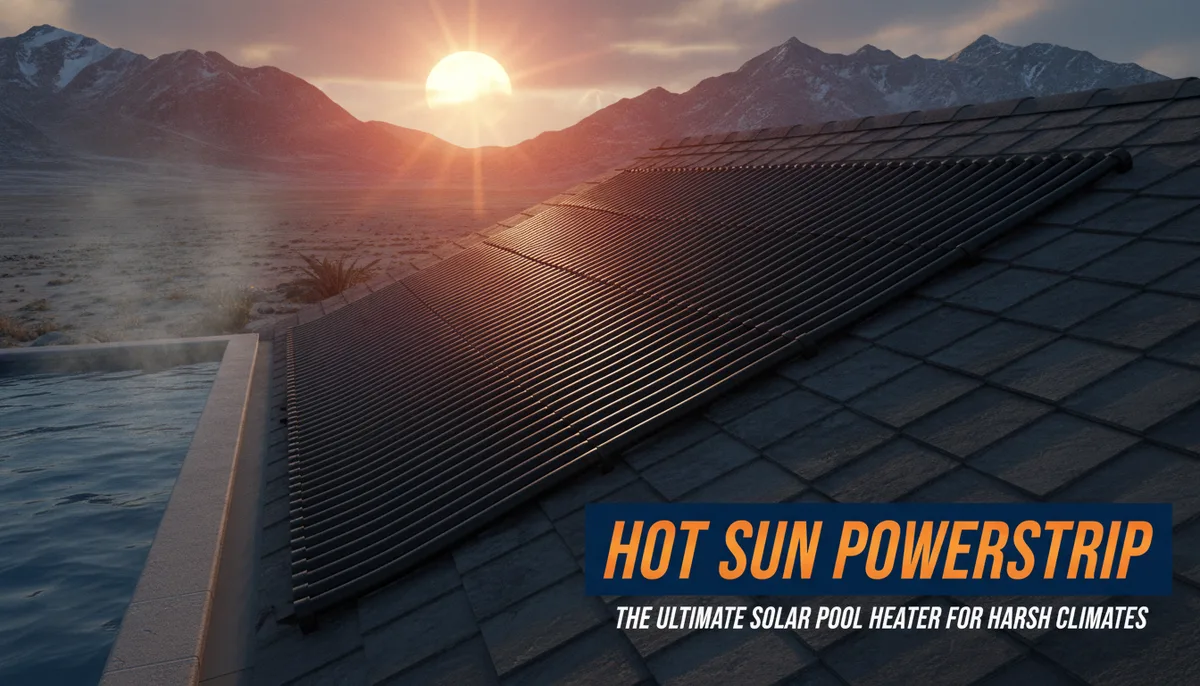
Why Hot Sun Powerstrip is the Ultimate Solar Pool Heater for Harsh Climates
When most homeowners think about solar pool heating, they picture rigid black plastic panels mounted to a roof. While that technology has served the industry for decades, it often fails in environments that experience extreme temperature fluctuations, high altitudes, or specific architectural challenges like tile roofs.
For the serious DIYer or the homeowner looking for a "set it and forget it" solution, the material science and engineering behind the Hot Sun Powerstrip system represent a significant leap forward. By moving away from standard polypropylene and embracing advanced polymers and flexible design, this system addresses the three primary killers of solar pool heaters: UV degradation, freeze-bursting, and installation-related roof leaks.
The Material Advantage: ASA vs. Polypropylene
The heart of any solar collector is the manifold—the header pipe that distributes water into the smaller riser tubes. Most commercial solar pool heaters use a proprietary blend of polypropylene. While cost-effective, polypropylene has limitations in terms of raw strength and thermal resilience.
Hot Sun utilizes a pre-compounded ASA (Acrylonitrile Styrene Acrylate) blend for its manifolds. While this material is more expensive to produce, the technical benefits are substantial:
- Tensile Strength: Hot Sun manifolds boast a tensile strength of 7800 psi, compared to the 4800 psi typically found in pre-compounded polypropylene blends. This higher strength allows the system to handle the pressure spikes and physical stresses of a pool pump environment with a much higher safety margin.
- Thermal Capability: The melt temperature of the ASA resin used by Hot Sun is over 500°F. In contrast, standard polypropylene blends hover around 340°F. In "stagnation" events—where the pump is off but the sun is hitting the collectors—temperatures can skyrocket. ASA maintains its structural integrity far longer than lower-grade plastics.
- Surface Finish and Durability: ASA provides a much harder surface finish. It is naturally more scratch-resistant and fade-resistant, ensuring the system looks professional on your roof for decades rather than turning a chalky grey after a few seasons of intense UV exposure.
- Adhesive Compatibility: One of the most practical advantages of ASA is that it "takes" to adhesives. This allows installers to glue fittings directly to the manifolds, providing a level of customization and leak-free security that mechanical clamps on polypropylene often struggle to match.
heavy duty PVC solvent cement for professional plumbing
Understanding these material differences is crucial when planning your system. For a deeper look at how these materials interact with solar energy, see The Science of Solar Pool Heating: A DIY Guide to Efficiency and Design.
Solving the Freeze-Burst Paradox
In traditional solar pool heating design, winterization is not optional; it is a critical maintenance task. If water is trapped in a rigid pipe or a standard collector and that water freezes, it expands by approximately 9%. In a rigid polypropylene or PVC pipe, that expansion has nowhere to go, resulting in a burst pipe and a costly repair bill in the spring.
Hot Sun’s Powerstrip fin tubing solves this through mechanical flexibility. Unlike rigid riser tubes, these flexible fin tubes can freeze solid full of water. Because the material can stretch and expand to accommodate the ice, the tubes remain undamaged once the thaw occurs.
This is a game-changer for climates like Denver, Colorado, or high-altitude regions near Las Vegas. In these areas, a clear spring night can lead to "night sky radiation." Even if the ambient air temperature is 37°F, your solar collectors act as a radiator to the cold void of space, potentially dropping the water temperature inside the tubes below freezing. While you should still empty your main manifolds and supply piping for the winter, the "forgiveness" of the flexible fin tubes provides a massive safety net against unexpected overnight frosts.
Climate-Specific Design: Why Location Matters
The geography of your home dictates the stress your solar system will endure. In warm, coastal, temperate regions, almost any solar heater will perform adequately. However, as you move into regions with high diurnal temperature swings (hot days, very cold nights), the limitations of standard systems become apparent.
In high-altitude locations, the UV index is higher, and the cooling effect of the night sky is more pronounced. Hot Sun systems are designed with these "marginal" climates in mind. Because the fin tubing can run horizontally without the fear of trapped water causing a burst during a light freeze, you have significantly more flexibility in how you orient the system on your roof.
digital infrared thermometer for monitoring collector temperature
When designing your layout, it's vital to ensure you have the right parts for your specific environment. You can find a breakdown of these parts in The PoolHeatHacker Master Buying Guide: Essential Components for DIY Heating.
Installation Without Compromise: The Tile Roof Solution
One of the biggest hurdles for solar adoption is the fear of roof leaks, particularly on tile roofs. Traditional solar panels require mounting brackets that must be bolted through the tile and into the rafters. This creates dozens of potential leak points and often requires breaking or drilling through expensive tiles.
Hot Sun addresses this with a ballasted framework system. This framework securely supports the entire Powerstrip solar pool heating system using locally available materials (such as weighted blocks or specialized rails) that sit on top of the roof surface.
Benefits of the ballasted approach:
- Zero Roof Penetrations: On tile surfaces, you can avoid drilling entirely, preserving the integrity of your home’s secondary water barrier.
- Aesthetic Integration: The system is fitted row-by-row, capturing the full solar resource while maintaining an agreeable aesthetic that follows the lines of the architecture.
- Ease of Maintenance: If you ever need to replace a tile or perform roof maintenance, the ballasted system is much easier to shift or work around than a system bolted directly into the structure.
Maximizing Layout Efficiency
Because the Powerstrip system is flexible and uses ASA manifolds that can be customized with glued fittings, you aren't stuck with the "standard sizes" of traditional 4x10 or 4x12 panels. You can fit the tubing into odd-shaped roof sections, around vents, and into spaces where a rigid panel simply wouldn't fit.
This "row-by-row" fitting ensures that you are utilizing every square inch of available solar real estate. In the world of solar pool heating, square footage is the most important metric for performance. The more surface area you have exposed to the sun, the faster your pool will reach a comfortable temperature.
For those looking to take their efficiency to the next level, automating the flow of water based on the temperature differential between the roof and the pool is the gold standard. You can learn how to build your own controller in our guide on How to Automate Your DIY Heater with an Arduino: A Step-by-Step Technical Guide.
Long-Term Durability and ROI
Investing in a solar pool heater is an exercise in calculating Return on Investment (ROI). While a cheaper polypropylene system might have a lower upfront cost, the "hidden costs" of rigid systems include:
- Replacement Costs: Replacing panels that burst during a surprise freeze.
- Maintenance: Fixing leaks at manifold clamps that have loosened due to thermal expansion and contraction.
- Longevity: Dealing with brittle plastic after 10 years of high UV exposure.
The Hot Sun Powerstrip system, with its 500°F melt temp resin and freeze-tolerant tubing, is built to outlast the pool pump it's connected to. By choosing materials that are chemically and mechanically superior, you ensure that your "free heat" from the sun doesn't come with a high price tag of constant repairs.
solar pool cover to retain heat overnight
When you combine the material science of ASA with the practical flexibility of the Powerstrip fin tubes, you get a system that is uniquely suited for the modern DIYer who demands professional-grade results and long-term reliability. Whether you are in the scorching heat of the Mojave or the thinning air of the Rockies, your solar pool heater should be the most reliable part of your backyard oasis.