
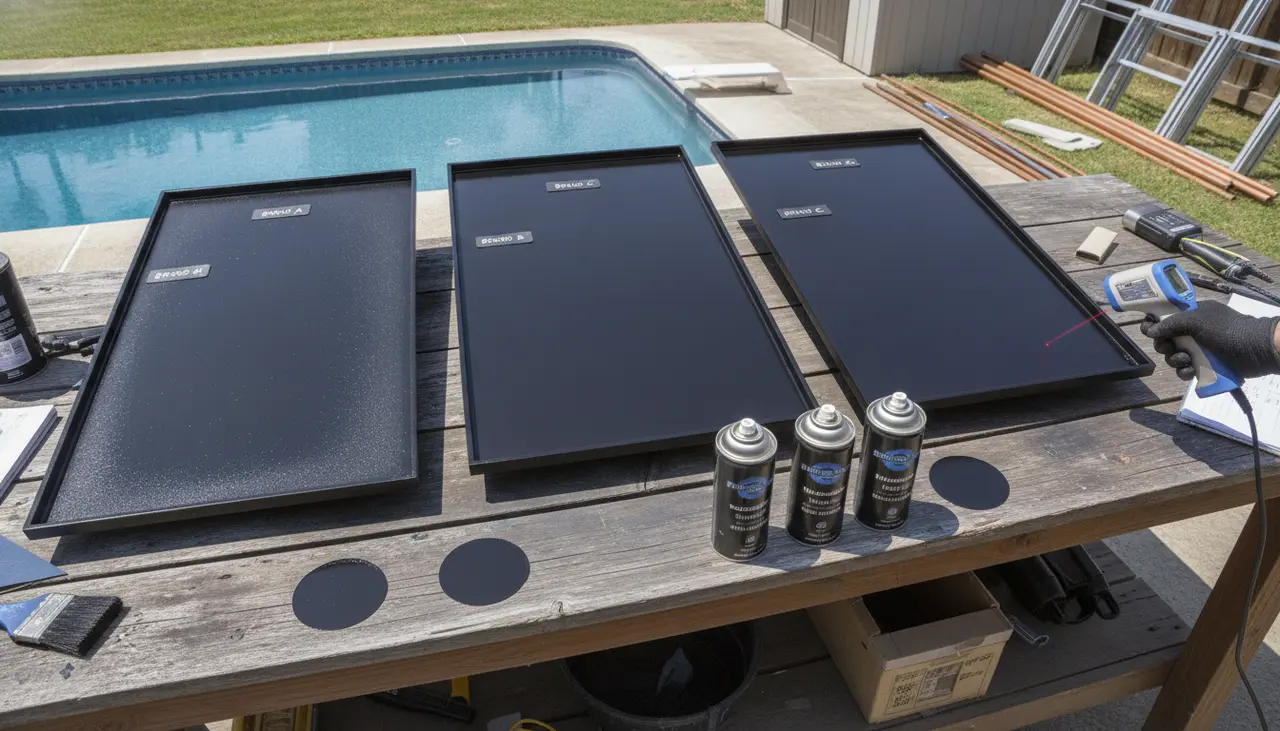
The Best UV-Resistant Flat Black Spray Paint for Solar Collectors
The most effective paint for a DIY solar collector is a flat black, high-heat, UV-resistant spray paint. Flat finishes have a higher emissivity and lower reflectivity than gloss or satin finishes, allowing the collector to absorb up to 95% of available solar irradiance. For polyethylene (PE) tubing and PVC, the paint must also be formulated to bond with plastics to prevent flaking during thermal expansion.
Why Paint Choice Matters for DIY Solar Heating
When building a solar collector, your goal is to convert solar radiation into thermal energy. Raw black polyethylene (PE) tubing is already dark, but it often has a semi-gloss finish that reflects a percentage of sunlight. Applying a specialized flat black coating increases the surface area's "absorptance."
However, the temperature of a stagnant solar coil (when the pump is off) can exceed 150°F. Standard hardware-store spray paint will often crack or peel under these conditions due to the different rates of thermal expansion between the plastic pipe and the paint film.
This guide identifies the specific coatings that maintain adhesion while maximizing heat transfer to your pool water.
Comparison of Top-Rated Solar Collector Paints
| Paint Type | Best Use Case | UV Resistance | Heat Rating | Adhesion to Plastic |
|---|---|---|---|---|
| Rust-Oleum High Heat | Metal heat exchangers / Manifolds | Excellent | Up to 1200°F | Moderate (requires primer) |
| Krylon Fusion All-In-One | Direct application to PE/PVC pipe | High | Up to 200°F | Excellent (no primer) |
| Rust-Oleum Specialty Plastic | PVC Diverter valves and fittings | High | Up to 150°F | Superior |
| VHT FlameProof | High-temp copper manifolds | Superior | Up to 2000°F | Low on plastics |
Top Picks for Solar Coil Applications
Best for Polyethylene (PE) Coils: Krylon Fusion All-In-One (Flat Black)
Polyethylene is notoriously difficult to paint because of its low surface energy. Krylon Fusion is specifically engineered to bond to plastic surfaces without sanding or priming.
- Pros: Bonds directly to poly pipe; does not require a separate primer; stays flexible to accommodate pipe expansion.
- Cons: Lower heat threshold than ceramic-based paints, though sufficient for most solar water applications.
Best for High-Efficiency Manifolds: Rust-Oleum Specialty High Heat
If your DIY build involves a copper or stainless steel heat exchanger inside a collector box, you need a paint that can handle extreme stagnation temperatures.
- Pros: Extremely durable; will not off-gas or peel at high temperatures; very high emissivity.
- Cons: Requires a "curing" process (often heat-based) to reach maximum hardness; can be brittle if applied too thickly on flexible plastic.
Technical Specifications to Look For
When shopping for "flat black spray paint for solar collector" use, prioritize these three technical metrics:
- Emissivity: This is the ratio of the energy radiated by a surface to the energy radiated by a black body at the same temperature. You want a rating as close to 1.0 as possible. Flat black paints typically range from 0.90 to 0.97.
- UV Degradation Resistance: Solar collectors are, by definition, exposed to maximum UV levels. Non-UV-rated paints will chalk and turn grey within one season, significantly dropping your heat gain.
- Thermal Conductivity: While the paint layer is thin, you want a coating that does not act as an insulator. Avoid "rubberized" coatings or thick textured paints.
For a full breakdown of the hardware needed to move water through these collectors, see The PoolHeatHacker Master Buying Guide: Essential Components for DIY Heating.
Common Beginner Mistakes
- Using Gloss Paint: Glossy surfaces reflect photons. Every reflected photon is a lost BTU. Always use "Flat" or "Ultra-Flat."
- Skipping the Cleaning Phase: PE pipe often has a "release agent" from the manufacturing process. If you don't wipe the pipe down with mineral spirits or acetone (carefully) before painting, the paint will peel within weeks.
- Painting the Entire Pipe: If you are using a "pipe-on-roof" method without a collector box, only paint the side facing the sun. Painting the back can actually increase heat loss via radiation to the roof surface.
- Ignoring the Fittings: Standard white PVC fittings are highly susceptible to UV degradation. Ensure you paint your essential PVC fittings to prevent the plastic from becoming brittle and cracking under pressure.
Step-by-Step Application for Maximum Durability
- Surface Prep: Wipe the poly pipe or PVC with a 50/50 mix of isopropyl alcohol and water.
- Scuffing: For PVC, lightly sand the surface with 220-grit sandpaper to create a "mechanical key" for the paint.
- Thin Coats: Apply three light coats rather than one thick coat. This allows the paint to remain flexible enough to expand and contract with the pipe as the water temperature fluctuates.
- Curing: Allow the paint to cure for at least 24 hours before running water through the system. Internal cooling from the water can interfere with the chemical bonding of the paint if it is still "outgassing."
FAQ
Does painting the pipe actually make a difference? Yes. Testing shows that flat black painted PE tubing can see a 5°F to 10°F increase in discharge temperature compared to unpainted, semi-gloss factory black tubing under the same solar irradiance.
Can I use regular "BBQ paint"? Yes, BBQ paint is essentially high-heat flat black paint. It works excellently on metal components but may require a plastic-adhesion promoter if used on PE or PVC pipes.
How often do I need to repaint? In high-UV environments (Arizona, Florida), a DIY collector may need a "refresh" coat every 2-3 seasons to maintain maximum absorptance.
Affiliate Disclosure: This post contains affiliate links for paint and plumbing components. If you purchase through these links, PoolHeatHacker may earn a small commission at no additional cost to you.