
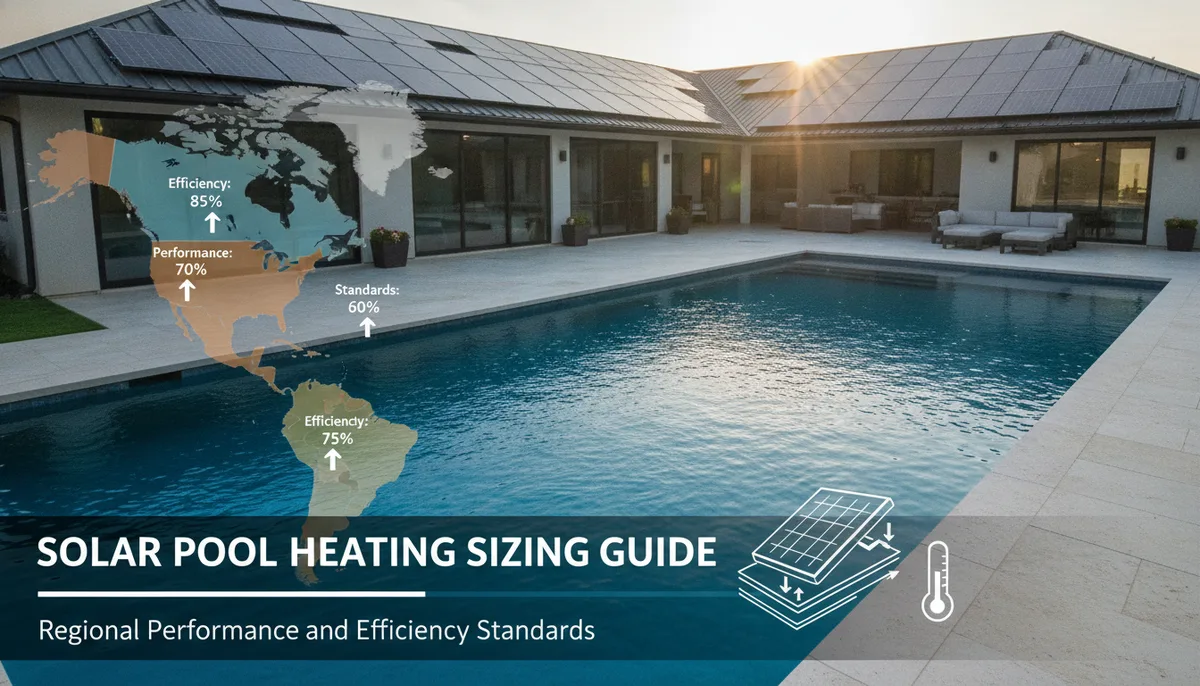
Solar Pool Heating Sizing Guide: Regional Performance and Efficiency Standards
Understanding Solar Pool Heating Performance Standards
When homeowners transition to solar pool heating, the most common question is: "How warm will my pool actually get?" The answer isn't a single number, but a calculation based on geographic location, environmental variables, and the ratio of solar collector area to the pool’s surface area.
To provide accurate expectations, we rely on decades of simulated and real-world data. The benchmarks used in this guide are derived from the Enerpool Pro simulation program—a high-level monitoring tool well-regarded across hundreds of real pool installations since 2003. By understanding these baseline performance charts, you can move away from guesswork and toward a scientifically backed heating strategy.
The 75% Rule: Calculating Your Collector Area
The gold standard for achieving what most users consider "satisfying results" is the 75% sizing rule. This means that your solar collector array should occupy a square footage equal to 75% of your pool’s total surface area.
For example, if you have a 15' x 30' pool (450 square feet), a full-sized solar system would require approximately 337 square feet of collector panels. This ratio is designed to provide a substantial "bump" over the natural temperature of an unheated pool. In many regions, this sizing represents the upper limit of what is necessary to maximize the swimming season without over-investing in hardware.
To understand the underlying physics of how these collectors interact with your pool's volume and the sun's energy, see our guide on The Science of Solar Pool Heating: A DIY Guide to Efficiency and Design.
Regional Performance Analysis: From California to Hawaii
Climate is the primary driver of solar efficiency. A system sized for Southern California will behave very differently than one installed in the Pacific Northwest or the tropics.
Southern California (San Diego and Los Angeles)
In the San Diego and Los Angeles regions, the data is remarkably consistent. Using weather data from LAX as a baseline, a standard 75% sizing achieves a 15-degree Fahrenheit increase in pool temperature over an unheated pool.
However, microclimates matter:
- Inland vs. Coastal: If you live further inland, you will experience higher peak temperatures in the summer but colder lows in the winter. While the daily highs change, the overall length of the solar swimming season remains relatively stable compared to coastal areas.
- The Wind Factor: Direct wind exposure, especially cool breezes coming off the ocean, can strip heat from both the pool surface and the solar collectors. Our standard performance charts assume no major direct wind exposure.
The Hawaii Adjustment
In Hawaii, the "standard" sizing formula used in the mainland U.S. is often too generous. Because the solar radiation is consistently higher and ambient temperatures rarely drop significantly, you can achieve excellent results by aiming for the lower end of the full-sizing range. Over-sizing in Hawaii can lead to a pool that is uncomfortably warm during peak summer months.
Success in Vancouver and Canada
It is a common misconception that solar heating is only for the "Sun Belt." Solar pool heating is incredibly popular in Canada, particularly in Vancouver, BC. While the absolute temperatures are lower than in California, the relative gain provided by solar collectors allows Canadian pool owners to double their swimming season, making it a highly cost-effective DIY project.
Environmental Variables and "Standard Conditions"
Performance charts are built on a set of "standard conditions." If your backyard deviates from these, you must adjust your expectations or your system size.
- Shading: Our baseline assumes 25% overall pool shading. If your pool is nestled in a lush, dark canyon or surrounded by high-rise buildings, your natural heat gain is lower, and you may need to increase your collector ratio.
- Roof Orientation: For maximum efficiency, collectors should be mounted on a South or Southwest facing roof. This ensures they catch the most intense "peak" sun during the afternoon.
- Nighttime Covers: The use of a pool cover for 12 hours per night is a critical variable. While many owners prefer not to use a cover for aesthetic reasons, doing so can add an additional 5 degrees to your pool's temperature by stopping evaporative cooling.
The Pool Depth Myth
A frequent point of confusion among DIYers is whether a deep pool requires more solar panels than a shallow pool. The data shows that pool depth does not affect the overall average temperature held by a solar system.
A shallower pool has less thermal mass, meaning it will heat up faster during the day but cool down faster at night. A deeper pool acts as a larger thermal battery; it takes longer to swing in temperature, resulting in more stability over a 24-hour period. However, the total energy required to maintain a specific average temperature is dictated by the surface area (where heat is lost) rather than the depth.
Optimizing Your System for Maximum Efficiency
Once you have determined your sizing, the focus shifts to hardware and plumbing. To ensure the heat captured by your panels actually makes it into the water, you need to minimize backflow and optimize flow rates. Integrating specific components like check valves is essential for preventing the "drain down" effect when the pump turns off.
For a detailed breakdown of the hardware required to build a high-performance system, refer to The PoolHeatHacker Master Buying Guide: Essential Components for DIY Heating.
Automation and Precision
To truly mirror the performance seen in simulation charts, automation is key. A system that only runs when the roof is significantly hotter than the water prevents the system from accidentally cooling the pool on overcast days.
Advanced DIYers often look toward custom solutions to manage this. If you are interested in the technical side of temperature regulation, you can explore How to Automate Your DIY Heater with an Arduino: A Step-by-Step Technical Guide.
Final Considerations for DIY Sizing
When planning your layout, remember that the charts represent the "upper limit" of what is considered full sizing. If you have limited roof space, you can still achieve satisfying results with 50% or 60% coverage; your "temperature bump" will simply be smaller (e.g., a 10-degree increase instead of 15).
Solar pool heating is a game of percentages and patience. By matching your collector area to your regional climate and using a cover to lock in those gains, you can transform a chilly, unused pool into a centerpiece of your home for the majority of the year.