
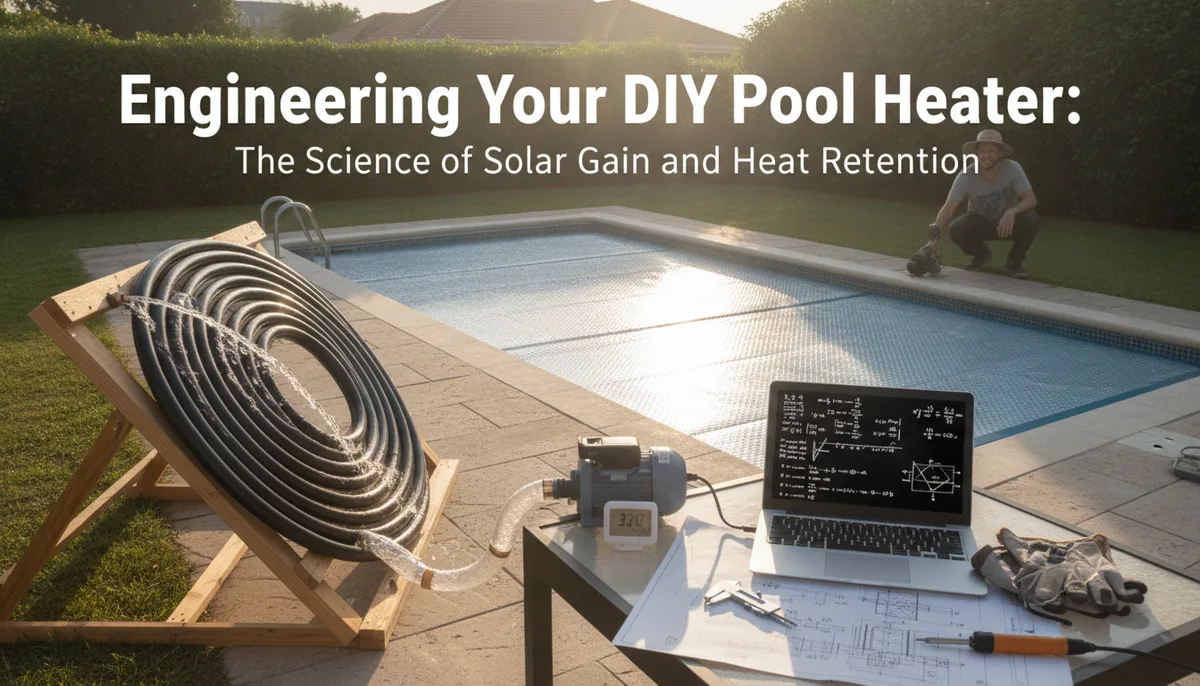
Engineering Your DIY Pool Heater: The Science of Solar Gain and Heat Retention
Building a DIY pool heater is more than an exercise in plumbing; it is an application of thermodynamics. While many hobbyists simply coil black garden hose on a roof, the difference between a system that "feels warm" and one that actually raises the temperature of 20,000 gallons of water lies in the engineering.
By utilizing the technical references provided by BuildItSolar, we can move beyond guesswork. This guide explores the fundamental principles of solar radiation, heat transfer, and fluid dynamics necessary to design a high-performance DIY heating system.
The Solar Resource: Calculating Potential Heat Gain
Before buying a single foot of pipe, you must understand the energy available at your site. The "Solar Constant" represents the energy reaching the Earth's upper atmosphere, but the energy hitting your backyard is filtered by the air, humidity, and geographic location.
Insolation and Tilt
Insolation is the measure of solar radiation energy received on a given surface area in a given time. To maximize this, your collector's orientation is critical. For pool heating—which is typically a seasonal activity—the ideal tilt angle is usually your latitude minus 10 to 15 degrees. This flattens the collector to catch the high summer sun.
If your collector is mounted on a roof that doesn't face true south, you aren't necessarily out of luck. A collector facing Southeast or Southwest still captures about 90% of available energy, provided it isn't shaded.
Measuring Efficiency
A collector's efficiency is defined by how much of the incoming solar radiation is actually transferred to the water.
Using a radiation meter allows you to find the "hot spots" in your yard before you finalize your installation.
Collector Physics: Glazed vs. Unglazed Systems
One of the biggest design decisions in DIY solar is whether to use "glazing"—a transparent cover made of glass, polycarbonate, or plastic film.
Unglazed Collectors
Most commercial pool heaters are unglazed plastic mats. These are highly efficient when the air temperature is higher than the pool water temperature. Because there is no glass to reflect sunlight, they absorb nearly all the visible spectrum. However, they are vulnerable to "wind wash," where a breeze strips the heat directly off the collector surface.
Glazed Collectors
If you intend to extend your swimming season into the spring or fall, glazing is mandatory. The glazing creates a "greenhouse effect," trapping long-wave infrared radiation and providing a stagnant air buffer that reduces convective heat loss. For those building custom boxes, The PoolHeatHacker Master Buying Guide: Essential Components for DIY Heating provides a breakdown of the materials needed to construct these high-efficiency enclosures.
Thermodynamics of Heat Loss
Heating a pool is a constant battle against three types of heat loss: conduction, convection, and radiation.
- Evaporation (Convection/Mass Transfer): This is responsible for up to 70% of a pool's heat loss. As water turns to vapor, it carries away a massive amount of energy (the latent heat of vaporization).
- Radiation: On a clear night, your pool radiates heat to the cold "sink" of outer space.
- Conduction: This is the heat lost through the walls and floor of the pool into the surrounding ground, though this is usually the smallest percentage of loss in above-ground setups.
To combat these, engineering a heater is only half the battle; you must also engineer a retention strategy. Without a solar cover, your DIY heater is likely just replacing the heat lost overnight rather than increasing the baseline temperature.
Fluid Dynamics: Why High Flow Wins
A common misconception in DIY pool heating is that slower water flow is better because the water coming out of the pipe "feels hotter." In reality, the opposite is true for system efficiency.
The Delta-T Principle
The "Delta-T" ($\Delta T$) is the temperature difference between the water entering the collector and the water leaving it.
- High $\Delta T$ (Slow Flow): The collector gets very hot. Because the collector is much hotter than the surrounding air, it loses a significant portion of its heat to the atmosphere before it can reach the pool.
- Low $\Delta T$ (Fast Flow): The collector stays cool—only a few degrees warmer than the pool. Because the temperature gradient between the collector and the air is small, heat loss is minimized, and more total BTUs are transferred to the water.
To achieve this, you need a pump capable of overcoming "head pressure" (the resistance caused by pipe friction and gravity). For a technical deep-dive on selecting the right hardware, see our guide on Best High-Flow Pool Pumps for DIY Solar Collectors: A Technical Guide.
Material Science: Choosing the Right Components
The BuildItSolar references emphasize the durability of materials under UV exposure and chemical stress. In a pool environment, your heater is exposed to high UV levels and chlorinated water, which can be highly corrosive to certain metals.
PVC and Temperature Ratings
Standard Schedule 40 PVC is the backbone of most DIY systems. However, its structural integrity begins to drop as temperatures rise. If your pump fails and the water sits stagnant in a glazed collector, temperatures can easily exceed 150°F, potentially softening or warping the pipe.
When designing your manifold, ensure you are using high-quality fittings that can handle the pressure cycles of a pool pump. For a list of the specific connectors required for a leak-proof build, refer to Essential PVC Fittings Every DIY Heater Needs: A Pool Plumbing Fittings Guide.
Absorber Materials
- Copper: Excellent thermal conductivity but expensive and susceptible to corrosion if pool pH is not perfectly balanced.
- PEX: Durable and handles heat well, but has lower thermal conductivity than metal, requiring longer runs.
- Polypropylene: The industry standard for unglazed mats due to its UV resistance and chemical inertness.
Optimization: The BuildItSolar Methodology
To wrap these principles into a functional project, follow this engineering checklist derived from the BuildItSolar reference data:
- Calculate Load: Determine the surface area of your pool. To see a significant temperature rise, your solar collector area should be 50% to 100% of the pool's surface area.
- Minimize Friction: Use the largest diameter pipe feasible for your manifolds to reduce the load on your pump.
- Insulate the Back: If building a collector box, use R-max or polyisocyanurate foam board behind the absorber plate. Unlike standard EPS (Styrofoam), these boards do not melt at the temperatures found inside a glazed solar box.
- Automate: Use a differential temperature controller. This ensures the pump only runs when the collector is actually hotter than the pool, preventing the system from accidentally cooling the pool on cloudy days or at night.
Conclusion
Engineering a DIY pool heater is an exercise in efficiency. By understanding that high flow rates, proper tilt, and minimized convective loss are more important than how "hot" the water feels to the touch, you can build a system that rivals commercial installations. Use the data, trust the physics, and you’ll enjoy a warm pool long after your neighbors have closed theirs for the season.