
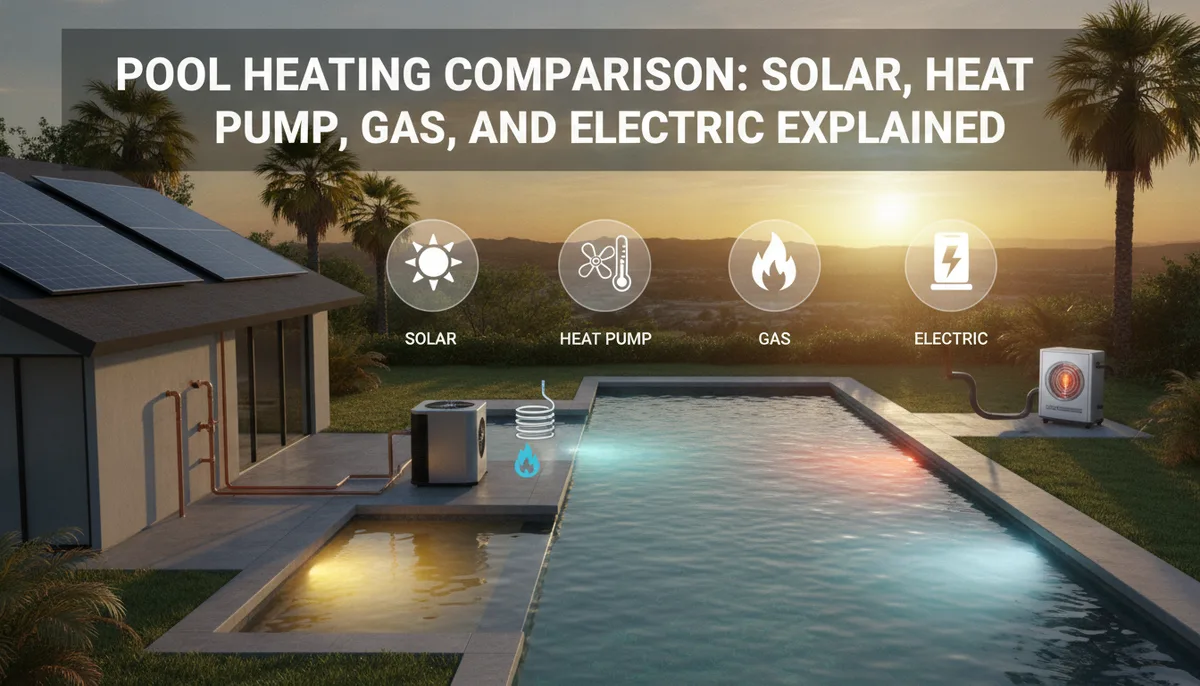
Pool Heating Comparison: Solar, Heat Pump, Gas, and Electric Explained
The Economics of Pool Heating: Understanding Your Options
Investing in a pool is a significant commitment, but the utility of that investment is often limited by the temperature of the water. For many regions, an unheated pool is only comfortable for a few months of the year. To extend the season—or to enjoy a swim in the early morning or late evening—a heating system is essential.
However, not all heating methods are created equal. The "best" system is a moving target that depends on your local climate, how often you use the pool, and your tolerance for monthly utility bills. When evaluating options, we look at three primary factors: initial capital cost, ongoing operational costs, and "heating speed" (how fast the system can raise the water temperature).
Before diving into specific hardware, it is vital to understand that the most efficient heater in the world cannot overcome a lack of insulation. According to thermal dynamics, the majority of pool heat loss occurs at the surface through evaporation. Without a pool cover, you are essentially trying to heat the outdoors.
Solar Pool Heating: The Zero-Fuel Solution
Solar pool heating is widely considered the most environmentally friendly and cost-effective long-term solution. Unlike solar PV (photovoltaic) panels that create electricity, solar thermal collectors for pools are designed to heat water directly.
How Solar Collectors Work
The system works by diverting pool water through a series of collectors, usually mounted on a roof or a nearby rack. These collectors are typically made of high-quality UV-resistant plastic or rubber. As the sun strikes the panels, the water inside absorbs the thermal energy before returning to the pool.
The beauty of solar is its simplicity. Because pools require "low-grade" heat (raising a large volume of water by 10 to 15 degrees rather than a small amount to boiling), these collectors do not need glass glazing or heavy insulation to be effective. For a deeper look at the physics behind this, see The Science of Solar Pool Heating: A DIY Guide to Efficiency and Design.
DIY vs. Commercial Solar
A professionally installed solar system can cost between $3,000 and $7,000. However, for the DIY enthusiast, solar offers the highest potential for savings. By sourcing your own collectors and handling the plumbing, you can often build a system for a fraction of the retail price.
The primary drawback of solar is its dependence on the weather. If it is cloudy or raining, the system will not provide heat. This makes solar an excellent "season extender" but perhaps not a standalone solution for those who want a guaranteed 85°F pool on a specific date in April.
Heat Pumps: Extracting Energy from Thin Air
If solar is the marathon runner of pool heating, the heat pump is the steady hiker. Heat pumps have gained massive popularity because they are significantly more efficient than electric resistance heaters.
Understanding COP (Coefficient of Performance)
The efficiency of a heat pump is measured by its COP. A standard electric heater has a COP of 1.0, meaning 100% of the electricity is converted into heat. In contrast, a pool heat pump typically operates at a COP between 3.0 and 7.0. This means for every $1 of electricity you spend, you get $3 to $7 worth of heat.
How is this possible? The heat pump doesn't create heat; it moves it. It uses a fan to pull in warm ambient air, passes it over an evaporator coil containing refrigerant, and then uses a compressor to intensify that heat.
Climate Limitations
The main caveat with heat pumps is their reliance on air temperature. Most units lose efficiency rapidly when the air temperature drops below 50°F (10°C). They are ideal for climates where the air is consistently warm but the pool water needs a boost.
When installing a heat pump, the plumbing layout is critical to ensure the pump doesn't work harder than necessary. You may need specific components to manage the flow. Refer to The PoolHeatHacker Master Buying Guide: Essential Components for DIY Heating for a checklist of what you'll need for a successful installation.
Gas Heaters: Reliability and Raw Power
Gas heaters (Natural Gas or Propane) are the traditional heavyweights of the industry. They operate by burning fuel inside a combustion chamber where copper or cupro-nickel coils transfer the flame's heat to the water.
When Gas Makes Sense
Gas heaters are the only choice for "on-demand" heating. If you have a spa that you want to heat from 60°F to 100°F in under an hour, gas is the only viable option. They are also weather-independent; a gas heater will work in a blizzard just as well as it works in July.
The Cost of Speed
The downside is the operational cost. Gas is almost always the most expensive way to heat a pool. With fluctuating fuel prices, maintaining a large pool at a constant high temperature with gas can result in monthly bills in the hundreds or even thousands of dollars.
For many, gas is best used as a secondary "booster" in a hybrid system. You can use solar for your daily baseline and kick on the gas heater only when you have guests coming over or for a weekend party. When integrating multiple heat sources, Integrating a Check Valve: Preventing Backflow in DIY Pool Heating Systems is a vital read to protect your equipment from damage.
The Critical Element: Why Pool Covers are Non-Negotiable
No discussion of pool heating is complete without mentioning the pool cover. Regardless of which heater you choose, the pool cover is the single most important piece of equipment for efficiency.
According to data from the Department of Energy and BuildItSolar, evaporation accounts for about 70% of total heat loss from a pool. A cover acts as a vapor barrier, stopping that evaporation in its tracks.
- Thermal Blankets: These look like heavy-duty bubble wrap and float on the surface. They are inexpensive and highly effective.
- Liquid Covers: These are chemical additives that create a one-molecule-thick layer on the water. While less effective than a physical cover, they are better than nothing and require zero labor.
- Automatic Covers: These are expensive but offer safety and convenience, making it much more likely that the pool will actually stay covered when not in use.
If you heat your pool without a cover, you are essentially throwing money into the wind. In many cases, adding a cover can reduce your heating costs by 50% or more.
Decision Matrix: Which Heater is Right for You?
To help narrow down your choices, consider the following scenarios:
- The Budget-Conscious DIYer: Solar is your best bet. The initial investment is low if you do the work yourself, and the operating cost is essentially zero.
- The "I Want it Now" Owner: If you use your pool sporadically and want it warm immediately, gas is your only option.
- The Consistent Swimmer: If you live in a moderate to warm climate and want to maintain a steady temperature all season for morning laps, a heat pump offers the best balance of efficiency and reliability.
- The Cold-Climate Owner: If you are trying to swim in a region where the air is frequently below 50°F, you will likely need a gas heater, as heat pumps and solar will struggle to keep up.
| Feature | Solar | Heat Pump | Gas |
|---|---|---|---|
| Initial Cost | Moderate to High | High | Moderate |
| Running Cost | Near Zero | Low to Moderate | High |
| Heating Speed | Slow | Moderate | Fast |
| Weather Dependent | Yes (Sun) | Yes (Air Temp) | No |
| Lifespan | 15-20 years | 10-15 years | 5-10 years |
Synthesizing Your Heating Strategy
The most sophisticated pool setups today often use a "hybrid" approach. By combining the strengths of different systems—such as using solar for the "free" bulk heating and a heat pump or gas heater for the final few degrees of comfort—you can achieve a warm pool with a manageable carbon footprint and utility bill.
Always remember that the efficiency of your system is only as good as its weakest link. Proper plumbing, the use of check valves to prevent backflow through solar collectors at night, and the consistent use of a pool cover are what separate a high-performance system from a money pit. By understanding the science and the hardware, you can hack your pool's temperature and enjoy a much longer, more comfortable swimming season.