
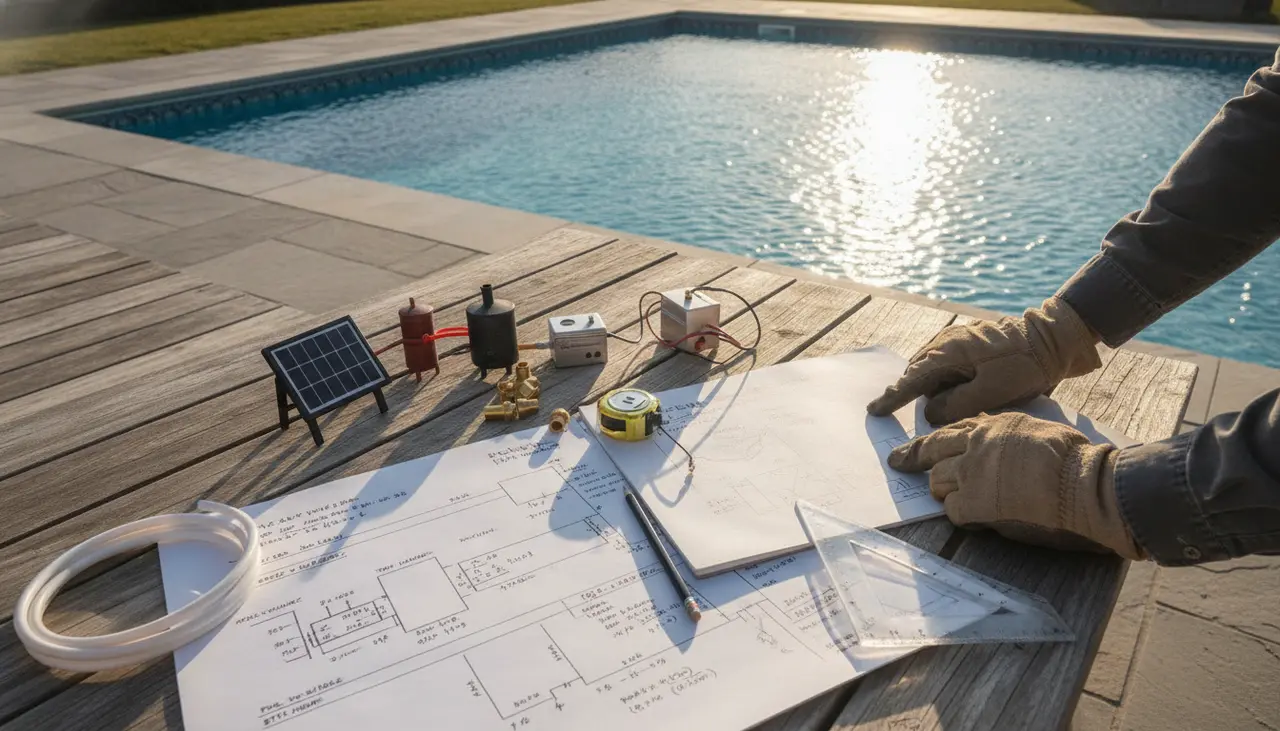
How to Calculate BTU Requirements for Your Pool: A DIY Sizing Guide
To calculate the BTU (British Thermal Unit) requirements for your pool, use the following formula: (Pool Volume in Gallons x 8.33) x Desired Temperature Rise = Total BTUs Required. To determine the hourly BTU output needed from your DIY heater, divide the total BTUs by the number of hours you intend to run the system.
A BTU is defined as the amount of heat energy required to raise the temperature of one pound of water by one degree Fahrenheit. Because water is heavy and has a high specific heat capacity, heating even a small above-ground pool requires significant energy output.
Who This Guide Is For
This guide is designed for DIY enthusiasts building solar collectors, wood-fired exchangers, or modified electric/gas systems. If you are sourcing your own copper coils or black poly piping, you must understand these calculations to ensure your pump flow rate and collector surface area are sufficient to meet the thermal demand.
Step 1: Calculate Total Water Weight
Before you can determine heat requirements, you must know the weight of the water you are heating.
- Convert to Weight: Multiply the total gallons by 8.33 (the weight of one gallon of water in pounds).
Example: A 15-foot round pool with a 4-foot depth holds approximately 5,310 gallons. 5,310 x 8.33 = 44,232 lbs of water.
Step 2: Determine Desired Temperature Rise
Identify the "Delta T"—the difference between your current water temperature and your goal temperature. If your pool is currently 70°F and you want it to be 80°F, your temperature rise is 10°F.
Step 3: The BTU Calculation
Using the figures from the examples above:
- Total BTUs: 44,232 (lbs) x 10 (degrees) = 442,320 BTUs.
This is the total energy required to reach your goal. However, DIY systems are not 100% efficient, and heat is lost to the atmosphere during the heating process.
Step 4: Accounting for Time and Flow Rate
Most DIYers want to reach their target temperature within a specific window (e.g., 24 hours).
- Hourly BTU Requirement: 442,320 / 24 = 18,430 BTUs per hour.
If your DIY heater (such as a wood-fired coil) only outputs 10,000 BTUs per hour, it will take 44 hours to reach your goal, assuming zero heat loss. To move this heat effectively, you must ensure your pump can handle the head pressure of your DIY manifold. For more on selecting hardware, see our Best High-Flow Pool Pumps for DIY Solar Collectors: A Technical Guide.
BTU Requirements by Pool Size (10°F Temperature Rise)
| Pool Size (Gallons) | Total Water Weight (Lbs) | Total BTUs Needed | BTU/hr (8-Hour Run Time) |
|---|---|---|---|
| 2,000 (Small Stock Tank) | 16,660 | 166,600 | 20,825 |
| 5,000 (15' Round) | 41,650 | 416,500 | 52,062 |
| 10,000 (12'x24' Rect) | 83,300 | 833,000 | 104,125 |
| 15,000 (18'x33' Oval) | 124,950 | 1,249,500 | 156,187 |
Practical Tradeoffs in DIY Heating
When building your own system, you face a tradeoff between Volume and Intensity.
- Solar Poly Pipe: Low intensity, high volume. You need massive amounts of tubing (often 400ft+ of 1/2" PE pipe) to capture enough solar irradiance to meet BTU goals.
- Wood-Fired Exchangers: High intensity, low volume. These produce high BTUs in a small footprint but require constant fuel management and specific materials to prevent melting. You can find a list of necessary hardware in The PoolHeatHacker Master Buying Guide: Essential Components for DIY Heating.
The "Hidden" Variable: Heat Loss
Calculations often fail because they ignore evaporation. Evaporation accounts for roughly 70% of a pool's heat loss. If your DIY heater is adding 20,000 BTUs per hour but your pool is losing 25,000 BTUs per hour due to wind and overnight temperature drops, the water temperature will decrease despite the heater running.
Pro-Tip: Always pair a DIY heater with a solar cover. This acts as a "thermal battery," retaining the BTUs you worked to generate.
Common Beginner Mistakes
- Undersizing the Collector: Many DIYers build a small 4'x4' solar coil for a 10,000-gallon pool. This will likely provide less than 5,000 BTUs per hour, which is insufficient to overcome natural heat loss.
- Ignoring Flow Velocity: If water moves too fast through a copper heat exchanger, it doesn't have time to absorb heat. If it moves too slow, the water may boil or damage PVC plumbing. Use a flow meter to stay within the 2-5 GPM range for most DIY heat exchangers.
- Incorrect Pipe Sizing: Using 1/2" pipe for long runs creates massive head pressure, which can burn out standard pool pumps.
FAQ
How many BTUs does a DIY solar heater produce? On a clear day, solar irradiance provides approximately 250-300 BTUs per square foot of collector per hour. A 40-square-foot collector can produce roughly 10,000 to 12,000 BTUs per hour under optimal conditions.
Does pipe color affect BTU gain? Yes. For solar applications, Black Polyethylene (PE) or UV-rated black PVC is essential. Black materials have a higher absorptivity constant, maximizing the conversion of solar radiation into thermal energy.
How do I calculate BTUs for a wood-fired heater? This is more complex as it depends on the BTU value of the wood (e.g., Oak provides ~24 million BTUs per cord) and the efficiency of your heat exchanger coil. Most DIY wood heaters operate at 30-50% efficiency.
Affiliate Disclosure: This post contains affiliate links to components like PVC fittings and pumps. If you purchase through these links, we may earn a commission at no extra cost to you.