
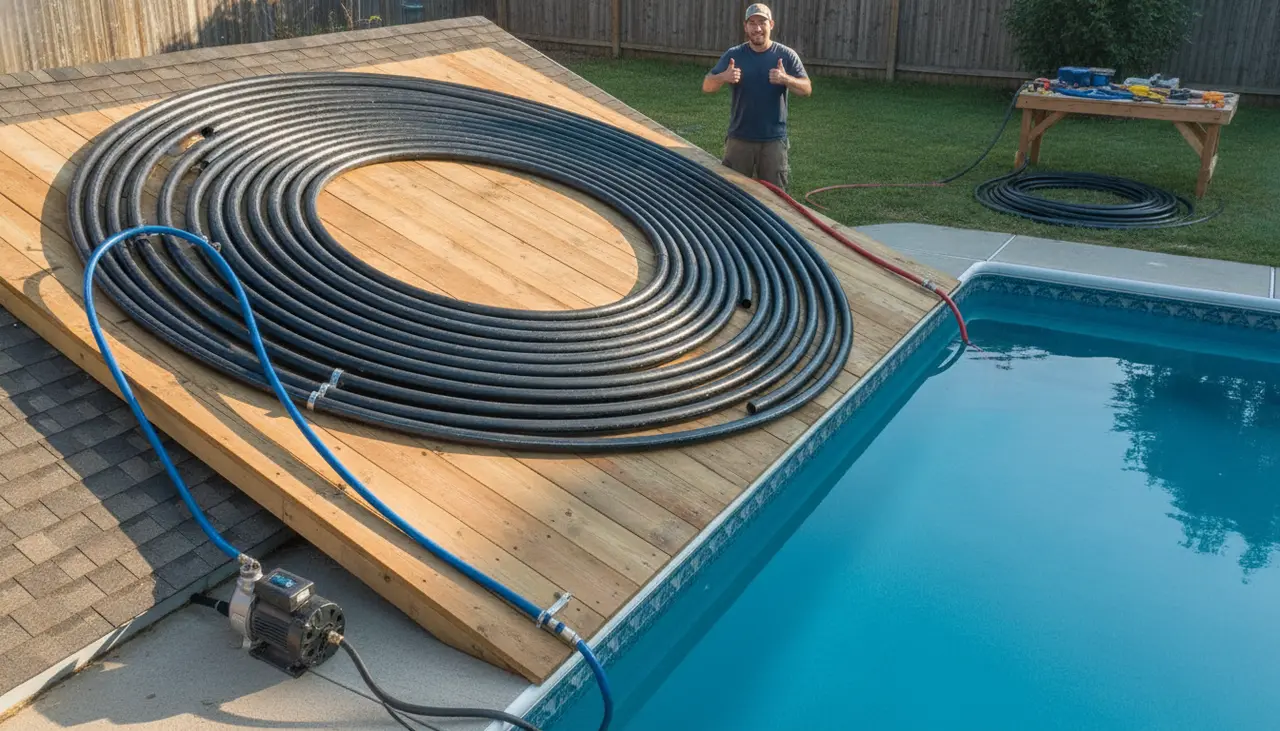
DIY Solar Pool Heater: The 100ft Poly Pipe Method
Building a DIY solar pool heater using the 100ft poly pipe method is one of the most cost-effective ways to raise your water temperature by 5°F to 10°F during the peak of summer. This method utilizes black polyethylene (PE) tubing coiled into a "pancake" shape to absorb solar irradiance and transfer that thermal energy directly into your pool water as it circulates through the coil.
To succeed with this build, you must balance flow rate with surface area. A single 100-foot coil of 1/2-inch poly pipe provides approximately 13 square feet of surface area. For most above-ground pools, a manifold system of three to five of these coils is required to see a significant impact on total pool volume temperature.
This guide is designed for backyard pool owners who want to bypass expensive commercial panels in favor of a modular, repairable system built from standard hardware store components.
Material Comparison: Solar Collector Tubing
When selecting your tubing, the material's thermal conductivity and UV resistance are the two most critical factors.
| Material | Thermal Conductivity | UV Resistance | Flexibility | Best Use Case |
|---|---|---|---|---|
| Black Poly (PE) | Moderate | High (Carbon Black) | High | Standard DIY solar coils |
| PEX (Cross-linked) | Moderate | Low (Requires paint) | Moderate | High-pressure systems |
| PVC (Rigid) | Low | Moderate | None | Manifolds and supply lines |
| Copper | Very High | Excellent | Low | High-efficiency heat exchangers |
Required Parts and Tools
To build one 100ft solar collector unit, you will need the following components. If you are building multiple units, multiply the quantities accordingly.
- 100ft Black Polyethylene (PE) Pipe: 1/2-inch or 3/4-inch diameter (100 PSI rated is sufficient).
- UV-Resistant Zip Ties: Heavy-duty, 8-inch or 12-inch lengths.
- Plywood Base: 4' x 4' exterior grade (1/2-inch thickness).
- UV-Resistant Matte Black Spray Paint: To coat the plywood and any non-black fittings.
- PVC Diverter Valve: 3-way valve for bypass control.
- Plumbing Fittings: 1/2-inch barb to 1/2-inch NPT adapters.
- Check Valve: To prevent back-drainage when the pump is off.
For a comprehensive list of high-quality valves and connectors, refer to The PoolHeatHacker Master Buying Guide: Essential Components for DIY Heating.
Step-by-Step Build Instructions
1. Prepare the Collector Base
Cut your plywood to a 4' x 4' square. Paint the board with matte black UV-resistant spray paint. This prevents the wood from rotting due to moisture and ensures that any sunlight passing between the pipe coils is absorbed by the board rather than reflected.
2. Coil the Poly Pipe
Lay the poly pipe in the center of the board. Create a tight circle and begin winding the pipe outward in a flat spiral.
- Pro Tip: Leave the pipe in the sun for 30 minutes before coiling; this makes the PE tubing more pliable and reduces the risk of kinking.
- Securing: Drill small holes in the plywood every 6 inches along four radial axes (forming a cross). Use UV-resistant zip ties to secure the pipe to the board as you wind.
3. Install the Manifold
If you are using multiple 100ft coils, do not connect them in a single long series. This creates excessive head pressure, which can burn out your pool pump. Instead, connect them in parallel. Use a PVC manifold to split the water flow evenly into each coil and then collect it back into a single return line.
4. Plumbing into the Pool System
Install a 3-way diverter valve on the return line of your pool's filtration system, after the filter but before the water returns to the pool. This allows you to control how much water is sent to the solar collectors.
- Inlet: Connect the "cold" side to the center of the spiral.
- Outlet: Connect the "hot" side to the outer edge of the spiral.
Technical Specifications and Calculations
To maximize the efficiency of your 100ft poly pipe heater, you must monitor the temperature differential ($\Delta T$).
- Optimal Flow Rate: Aim for a $\Delta T$ of 2°F to 5°F between the collector inlet and outlet. If the water coming out is "scalding," your flow rate is too slow, and you are losing efficiency to the surrounding air.
- BTU Estimation: On a clear day with high solar irradiance, a 100ft coil of 1/2" pipe can produce approximately 1,000 to 1,500 BTUs per hour.
- Head Pressure: Every 100ft of 1/2" poly pipe adds significant friction loss. Ensure your pump is rated for the additional "head" or use a dedicated booster pump if the collectors are mounted on a roof.
Common Beginner Mistakes
- Using Clear Tubing: Clear tubing creates a greenhouse effect but allows algae to grow inside the pipe, eventually clogging the system and contaminating the pool. Always use opaque black PE pipe.
- Oversizing the Coil: A single 500ft coil creates too much resistance for standard above-ground pool pumps. Stick to 100ft lengths joined in parallel.
- Ignoring the Check Valve: Without a check valve, water will drain out of the collectors back into the pool when the pump shuts off, creating air locks and potentially siphoning pool water.
- No Bypass Valve: Without a diverter/bypass valve, you cannot turn the heater off during the hottest weeks of summer or when performing maintenance.
Frequently Asked Questions
How many 100ft coils do I need? As a general rule, your solar collector surface area should be 50% to 80% of your pool's surface area. For a 15ft round pool (approx. 176 sq ft), you would ideally want 7 to 10 coils of 100ft poly pipe.
Can I mount these on my roof? Yes, but you must account for the vertical lift. Most small above-ground pool pumps cannot push water higher than 10-15 feet. Check your pump's flow curve before roof-mounting.
Should I cover the coils with glass or plexiglass? While a glazing cover (like glass) increases heat retention by reducing convective heat loss from wind, it also increases the weight and cost of the build. For most DIY setups, "open-air" coils are sufficient and much easier to maintain.
Affiliate Disclosure: As an Amazon Associate, I earn from qualifying purchases of components like poly pipe, zip ties, and plumbing fixtures mentioned in this guide.