
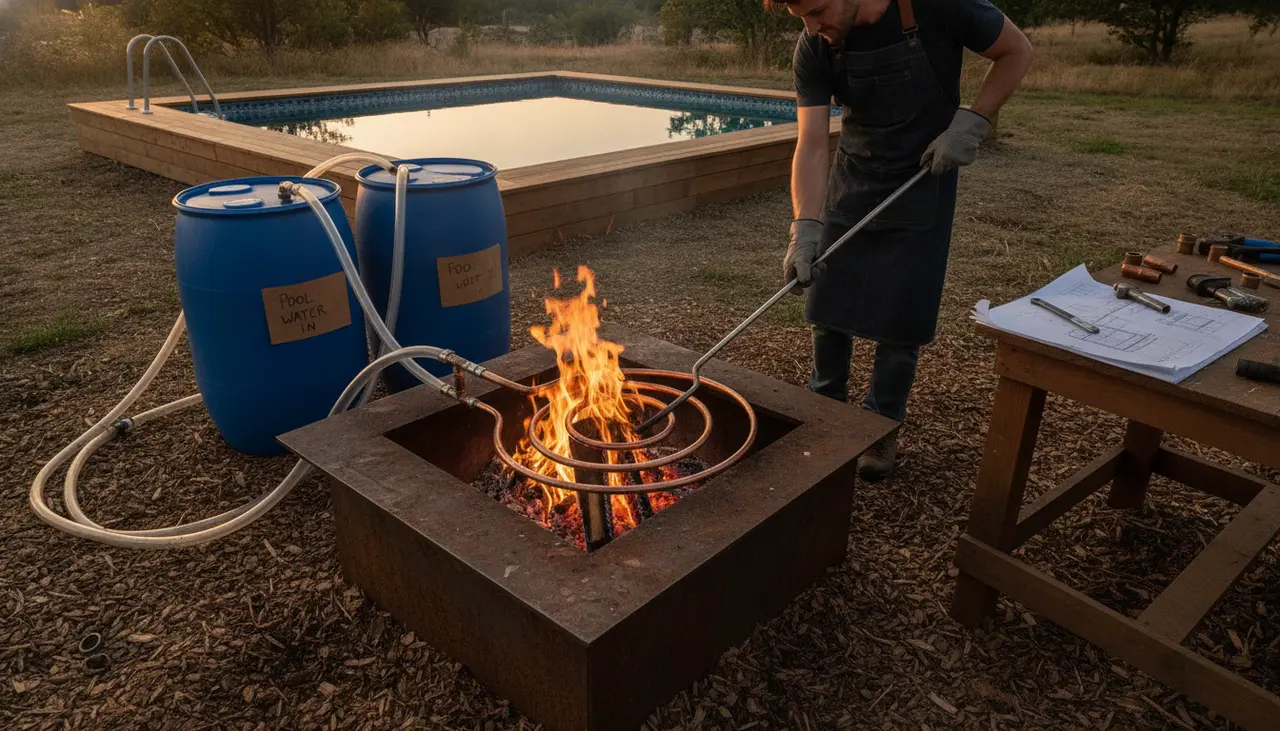
Building a Wood-Fired Pool Heater: Safety and Specs
A DIY wood-fired pool heater functions by circulating pool water through a heat exchanger—typically a copper coil—positioned inside a high-heat environment like a fire pit or wood stove. This method offers a significantly higher BTU output than solar collectors, allowing for rapid temperature increases even in cold weather.
To build this successfully, you must balance flow rate with thermal transfer. If the water moves too slowly, it can boil and create steam pockets; if it moves too fast, the temperature rise per pass will be negligible. This guide details the specifications for a copper-coil-based exchanger and the plumbing required to integrate it safely into your existing pool system.
Who This Guide Is For
This tutorial is designed for backyard pool owners and DIY enthusiasts who have access to firewood and want an off-grid or low-cost alternative to gas heaters. It assumes a basic understanding of PVC plumbing and mechanical assembly.
Heat Exchanger Material Comparison
| Feature | Copper Tubing (Type L or M) | Stainless Steel (304/316) |
|---|---|---|
| Thermal Conductivity | ~400 W/m·K (Excellent) | ~14-16 W/m·K (Poor) |
| Corrosion Resistance | Moderate (Sensitive to low pH) | High (Resists oxidation) |
| Workability | Easy to bend into coils | Difficult to bend without specialized tools |
| Cost | Moderate to High | High |
| Best For | Maximum heat transfer in compact pits | Long-term durability in high-salt environments |
Required Components and Specifications
To build a standard 50,000 to 100,000 BTU wood-fired exchanger, you will need the following materials. For a comprehensive list of plumbing fittings, refer to The PoolHeatHacker Master Buying Guide: Essential Components for DIY Heating.
- Heat Exchanger Coil: 50 to 100 feet of 1/2-inch or 3/4-inch soft copper refrigeration tubing.
- Plumbing to Exchanger: CPVC piping (rated for 200°F) for the first 5-10 feet of the return line.
- Diverter Valve: A 3-way PVC Jandy-style valve to control flow volume.
- Safety Valve: A 30 PSI pressure relief valve (T&P valve) installed on the hot water outlet.
- Temperature Gauges: Two inline thermometers (Inlet and Outlet) to monitor Delta T (temperature difference).
- Sealant: High-temperature fire mortar or 100% RTV silicone for transition points.
Step-by-Step Build Guide
1. Coiling the Copper
Using a 10-inch to 12-inch diameter cylindrical object (like a 5-gallon bucket or a section of large PVC), wrap the soft copper tubing tightly to create a continuous coil. Maintain a 1/2-inch gap between loops to allow smoke and heat to pass through the entire surface area of the pipe.
2. Constructing the Burn Chamber
The coil should be housed in a secondary chamber or elevated within a fire pit. Avoid placing the copper directly in the "cold" zone of the fire; it should be in the flame path but not resting on the coals, which can lead to localized overheating and soot buildup.
3. Plumbing and Diverter Setup
Do not run your full pump flow through the copper coil. The narrow diameter of the tubing creates significant head pressure.
- Install a PVC Diverter Valve on the main return line after the filter.
- Branch off a smaller line to the copper coil.
- Use CPVC (Cream-colored) for the connections entering and exiting the fire pit. Standard Schedule 40 PVC will soften and fail at the temperatures generated by wood-fired systems.
4. Safety and Pressure Management
A wood-fired heater is a "dead-head" risk. If the pump fails while the fire is burning, the water inside the coil will boil instantly.
- Mandatory: Install a Pressure Relief Valve on the outlet side before any shut-off valves.
- Check Valve: Install a check valve on the inlet side of the heater to prevent hot water from back-flowing into your pool filter or pump housing.
Calculating Performance (The Delta T)
To measure efficiency, use the standard BTU formula: `BTU/hr = GPM x 500 x Delta T`
If you are moving 5 Gallons Per Minute (GPM) and the water enters at 70°F and exits at 90°F (Delta T of 20), you are generating approximately 50,000 BTUs per hour. Unlike the DIY Solar Pool Heater: The 100ft Poly Pipe Method, which relies on UV irradiance, the wood-fired method is consistent regardless of weather.
Common Beginner Mistakes
- Using Thin-Walled Tubing: Avoid using flexible copper "utility" grade tubing. Use Type L or M to ensure the wall thickness can handle the pressure and thermal stress.
- Undersized Pump Flow: If your pump cannot overcome the head pressure of 100 feet of 1/2-inch tubing, the water will boil. Ensure your pump is rated for the additional lift and friction loss.
- Direct PVC Connection: Never connect standard white PVC directly to the copper coil. The heat will conduct through the copper and melt the PVC joint. Always use a CPVC or stainless steel transition nipple.
- Ignoring Heat Loss: A wood-fired heater is only effective if you retain the heat. Without a solar cover, you can lose up to 5°F overnight via evaporation.
FAQ
Can I use a stainless steel corrugated gas line for the coil? While stainless steel is more durable against pool chemicals, its thermal conductivity is much lower than copper. You would need significantly more surface area (longer pipe) to achieve the same heat transfer.
How do I prevent the copper from corroding? Copper is sensitive to low pH and high chlorine levels. Ensure your pool water is balanced. If your pH drops below 7.2, the acidic water will strip copper ions, potentially staining your pool liner green.
What happens if the pump stops while the fire is hot? This is a critical safety hazard. The water will turn to steam, and the pressure will spike. The pressure relief valve is your primary safety mechanism. Always extinguish the fire or bypass the heater if the pump is turned off.
Affiliate Disclosure: This post contains links to copper tubing, CPVC fittings, and high-temperature sealants. As an Amazon Associate, I earn from qualifying purchases at no additional cost to you.