
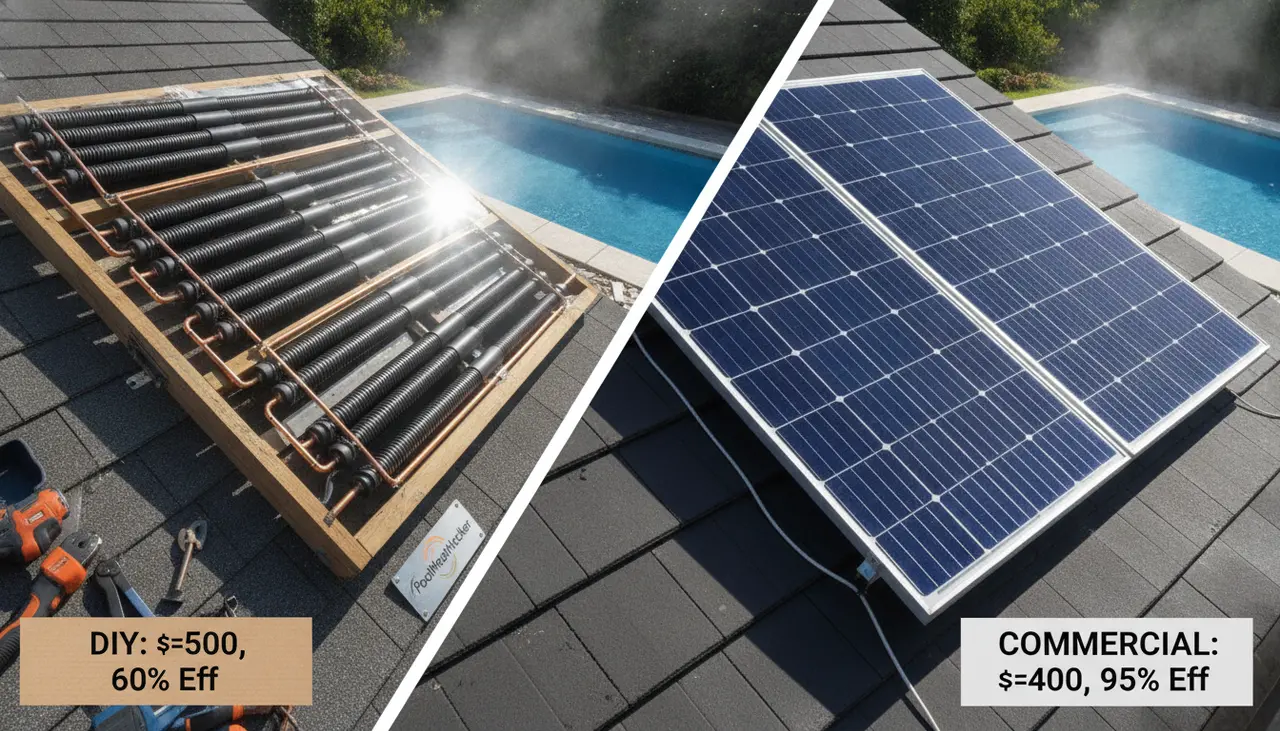
DIY Solar Collector vs. Commercial Solar Panels: Cost and Efficiency Comparison
The Short Answer: Which Should You Choose?
For most backyard pool owners, the choice between a DIY solar collector and commercial panels comes down to available roof space and upfront budget. A DIY collector using black polyethylene (PE) tubing is the most cost-effective method to raise water temperature, typically costing 60-70% less than commercial kits. However, it requires significantly more surface area to achieve the same heat gain.
Commercial solar panels (polypropylene mats) are engineered for maximum thermal conductivity and UV resistance. They are the better choice if you have limited roof space or want a "plug-and-play" installation with a documented BTU output. If you enjoy custom fabrication and have ample space for large coils, a DIY build offers the highest return on investment.
Who This Guide Is For
This comparison is designed for the DIY pool owner who wants to extend their swimming season without the high operational costs of gas heaters. Whether you are planning a ground-mounted array or a roof-mounted system, understanding the technical trade-offs between raw materials and manufactured kits is essential for a successful build.
Technical Comparison Table
| Feature | DIY Poly-Pipe Collector | Commercial Solar Panels |
|---|---|---|
| Primary Material | High-Density Polyethylene (HDPE) | UV-Stabilized Polypropylene |
| Typical Cost | $0.80 – $1.50 per sq. ft. | $5.00 – $9.00 per sq. ft. |
| Thermal Efficiency | Moderate (Lower surface area contact) | High (Tube-on-fin or web design) |
| Installation Time | High (Manifold assembly required) | Low (Modular connection kits) |
| Durability | 5–10 years (UV dependent) | 10–20 years |
| Customization | Infinite (Fits any shape/size) | Fixed (Standard panel dimensions) |
DIY Solar Collectors: The Poly-Pipe Method
DIY collectors are usually constructed using 1/2-inch or 3/4-inch black polyethylene (PE) tubing arranged in a "pancake" coil or a parallel grid.
Why it works: The black pigment in the tubing absorbs solar irradiance, transferring heat to the water flowing inside. Because the wall thickness of PE pipe is greater than that of commercial panels, the heat transfer is slightly slower, but the material is incredibly resilient to high pressures and freezing.
Key Components Needed:
- 100ft Poly Pipe Coils: The standard unit of measurement for DIY builds.
- PVC Manifolds: Custom-built using Schedule 40 PVC to distribute flow.
- Check Valves: Essential to prevent back-draining. For more on this, see Integrating a Check Valve: Preventing Backflow in DIY Pool Heating Systems.
Best For:
- Budget-restricted builds: When the goal is the lowest possible cost per BTU.
- Odd-shaped spaces: Ground mounts where standard 4x10 or 4x12 panels won't fit.
- High-pressure systems: DIY coils often handle higher PSI than thin-walled commercial mats.
Commercial Solar Panels: The Engineered Solution
Commercial systems, such as those from Fafco or Heliocol, use a "tube-on-fin" design. This maximizes the surface area exposed to the sun while keeping the water channels thin for rapid heat exchange.
Why it works: These panels are designed based on the principles of fluid dynamics to ensure even flow across the entire surface. This reduces "hot spots" and ensures every gallon of water passing through the system gains the maximum possible temperature differential. To understand the physics behind this, refer to The Science of Solar Pool Heating: A DIY Guide to Efficiency and Design.
Best For:
- Roof Installations: Lightweight and wind-resistant mounting hardware is usually included.
- Maximum Efficiency: When you need to heat a large pool with a small footprint.
- Longevity: Professional-grade materials are highly treated for UV and chemical resistance.
Practical Tradeoffs: Building vs. Buying
1. Heat Gain and BTU Output
A commercial panel can typically produce about 1,000 BTUs per square foot per day in optimal conditions. A DIY poly-pipe collector usually achieves 600-750 BTUs per square foot. To match the performance of four 4x12 commercial panels (192 sq. ft.), you would need approximately 250-300 sq. ft. of DIY poly-pipe coils.
2. Head Pressure and Pump Load
DIY coils, especially long single-run coils, create significant "head pressure" (resistance). If your pump isn't sized correctly, the flow rate will drop, and your heater will lose efficiency. Commercial panels use parallel headers to keep resistance low. If you are building a large DIY array, consult Best High-Flow Pool Pumps for DIY Solar Collectors: A Technical Guide to ensure your filtration pump can handle the lift.
3. Maintenance and Leak Points
- DIY: Every connection in a custom manifold is a potential leak point. Using high-quality stainless steel hose clamps and UV-rated PVC cement is mandatory.
- Commercial: Most leaks occur at the "O-ring" junctions between panels, which are easily replaced with standard kits.
Common Beginner Mistakes
- Undersizing the Array: A common mistake is installing only 50 sq. ft. of collector for a 15,000-gallon pool. You generally need 50% to 80% of the pool's surface area in solar collector coverage.
- Ignoring UV Ratings: Using standard black irrigation tubing that is not UV-stabilized will result in the pipe becoming brittle and cracking within two seasons.
- Flow Rate Imbalance: Sending water too fast through the collector doesn't allow it to pick up heat; sending it too slow can lead to the water boiling in the pipes and damaging the PVC. Aim for a 2-5 degree Fahrenheit temperature rise between the inlet and outlet.
FAQ: Solar Pool Heater Comparison
Is it cheaper to build a solar heater or buy one? Building is cheaper in terms of raw material costs. However, when you factor in the cost of PVC fittings, specialized valves, and the time required for assembly, the gap narrows. For a small above-ground pool, a DIY 100ft Poly Pipe Method is almost always cheaper.
How long do DIY solar collectors last? If using high-density polyethylene (HDPE) and UV-rated zip ties or mounting straps, a DIY collector can last 7–10 years. Commercial panels often carry warranties of 10–15 years.
Can I mix DIY and commercial panels? It is not recommended. The flow resistance (head pressure) is vastly different between the two. Water will follow the path of least resistance, usually through the commercial panels, leaving the DIY coils stagnant and ineffective.
Affiliate Disclosure: This post contains affiliate links for components like PE tubing, PVC fittings, and solar panels. If you purchase through these links, we may earn a small commission at no extra cost to you.