
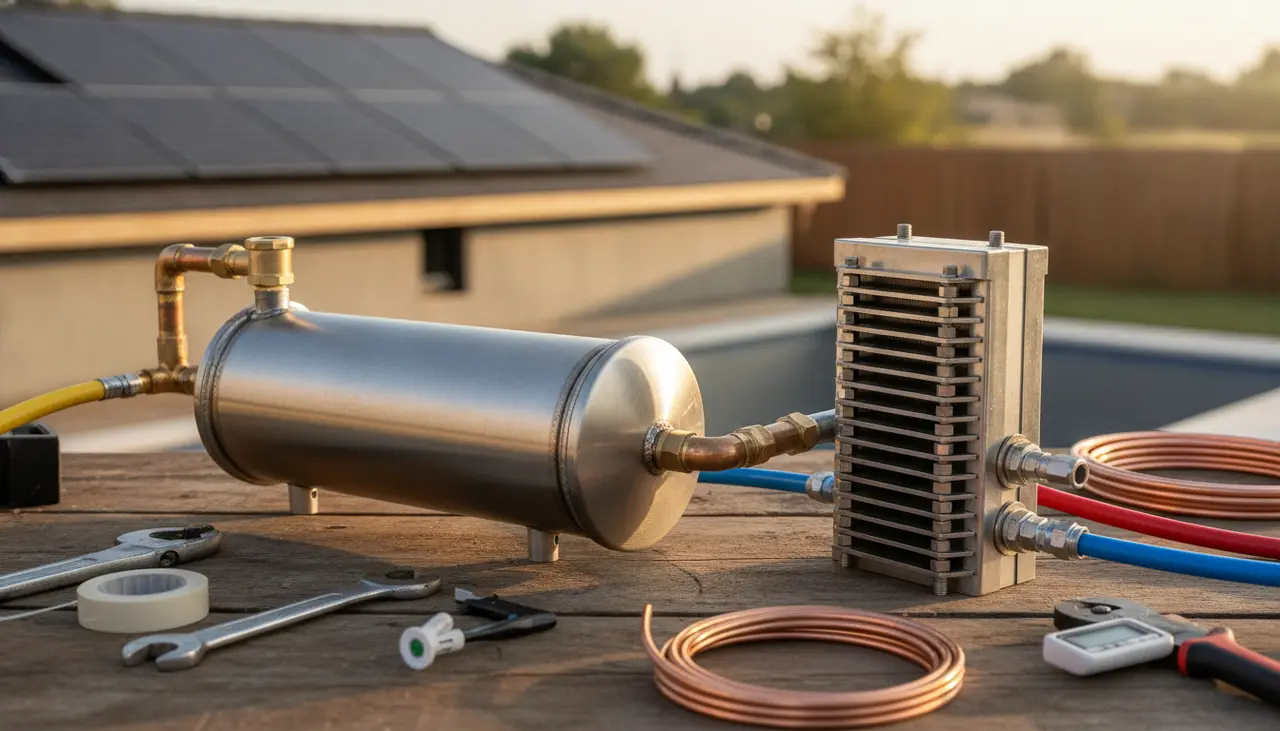
Best Heat Exchangers for DIY Gas Hookups: Stainless Steel Shell-and-Tube vs. Plate
Affiliate Disclosure: This post contains affiliate links. If you purchase a component through these links, we may earn a commission at no additional cost to you.
For most DIY pool heating projects—whether tapping into a home boiler or building a wood-fired rig—the 316L stainless steel shell-and-tube heat exchanger is the superior choice. It offers a low pressure drop, making it compatible with standard pool pumps, and is highly resistant to the debris often found in backyard pools. While brazed plate heat exchangers are more compact and thermally efficient, they are prone to clogging and create significant flow restriction (head pressure) that can stall a typical pool circulation system.
Who This Guide Is For
This guide is designed for DIYers who are bypassing expensive turn-key pool heaters in favor of custom builds. If you are plumbing a secondary heating loop from a domestic natural gas boiler, a propane tankless heater, or a custom outdoor furnace, the heat exchanger is the interface that transfers energy to your pool water without mixing the two fluids.
Comparison: Shell-and-Tube vs. Brazed Plate
| Feature | Shell-and-Tube (Stainless) | Brazed Plate (Stainless) |
|---|---|---|
| Primary Benefit | High flow rate, low maintenance | Maximum thermal efficiency, compact |
| Pressure Drop | Low (Minimal impact on pump) | High (Requires high-head pump) |
| Debris Tolerance | High (Wide internal tubes) | Low (Narrow channels clog easily) |
| Material | 316L Stainless Steel | 316L Stainless / Copper Brazing |
| Best Application | Wood-fired, Gas Boiler, Solar | High-efficiency indoor boiler loops |
Understanding the Technical Specifications
When shopping for a stainless steel heat exchanger for pool applications, look for these three critical metrics:
1. Material Grade: 316L vs. 304
Always specify 316L Stainless Steel. While 304 stainless is cheaper, it lacks the molybdenum content required to resist pitting corrosion from pool chlorine and salt. If you have a salt-water chlorine generator, even 316L has its limits; however, for standard chlorine pools, 316L is the DIY gold standard for longevity.
2. BTU Rating and Surface Area
Exchangers are typically rated by their maximum BTU output (e.g., 155,000 BTU, 250,000 BTU, or 1,000,000 BTU). This rating assumes a specific temperature differential (Delta T) between the hot source and the cold pool water.
- For Wood-Fired: Aim for a larger surface area to compensate for fluctuating fire temperatures. See our guide on Building a Wood-Fired Pool Heater: Safety and Specs for more on sizing.
- For Gas Boilers: Match the BTU rating of the exchanger to the output of your boiler.
3. Port Sizes and Flow Rates (GPM)
Pool pumps move a high volume of water at low pressure. Ensure the "Pool Side" ports are at least 1.5" or 2" FPT (Female Pipe Thread). If the ports are only 0.75" or 1", you will "choke" your pool pump, leading to motor strain and poor filtration.
Best For: High-Flow Gas Boiler Loops (Shell-and-Tube)
The shell-and-tube design consists of a series of small tubes inside a larger outer shell. The pool water typically flows through the shell, while the hot water from your gas source flows through the tubes.
- Pros: Easy to clean; handles high GPM flow rates; very low risk of "air locking."
- Cons: Takes up more physical space than plate exchangers.
- Technical Tip: Install the exchanger horizontally to prevent air pockets from forming in the shell.
Best For: Compact, High-Efficiency Setups (Plate Exchanger)
Plate exchangers use a series of corrugated plates to create a massive surface area in a tiny footprint.
- Pros: Near 99% thermal transfer efficiency.
- Cons: Extremely sensitive to calcium scale and small debris. You must install a Y-strainer on the inlet side to prevent the plates from clogging.
- Technical Tip: Ensure your pump can handle the "Head Pressure" listed in the plate exchanger's spec sheet. Most standard above-ground pool pumps will struggle with the resistance of a plate exchanger.
Common Beginner Mistakes to Avoid
- Undersizing the BTU Capacity: A 50,000 BTU exchanger will technically work, but it will take days to raise a 15,000-gallon pool by even 2 degrees. For most backyard pools, 155,000 BTU is the recommended minimum.
- Plumbing in Parallel vs. Series: Always plumb the heat exchanger on a "bypass" loop using a PVC diverter valve. This allows you to control the flow rate through the heater while maintaining full flow for the pool's filtration system.
- Ignoring the Check Valve: If the heat exchanger is located above the pool water level, water can drain back when the pump is off. This creates an air lock. Use a 2-inch swing check valve on the return line.
- Incorrect Flow Direction: Most exchangers are designed for "Counter-Flow." This means the hot water enters from the opposite side that the cold water enters. This maintains a high temperature gradient across the entire unit, maximizing heat transfer.
Frequently Asked Questions
Can I use a copper heat exchanger instead of stainless steel? Copper has better thermal conductivity than stainless steel, but it is highly susceptible to corrosion if your pool pH drops below 7.2. This can lead to copper staining on pool liners. Stainless steel is much more "forgiving" for DIY maintenance.
How many BTUs do I need for a 10,000-gallon pool? To raise 10,000 gallons by 1°F per hour, you need approximately 83,000 BTUs of actual heat transfer. Accounting for efficiency losses, a 155,000 BTU heat exchanger is a practical starting point for small-to-mid-sized pools.
Do I need a separate pump for the heat exchanger? On the "Pool Side," your main pool pump is usually sufficient if you use a shell-and-tube model. On the "Hot Side" (the boiler or wood stove loop), you will almost always need a dedicated circulator pump (like a Taco or Grundfos 3-speed pump) to move the hot water through the exchanger.